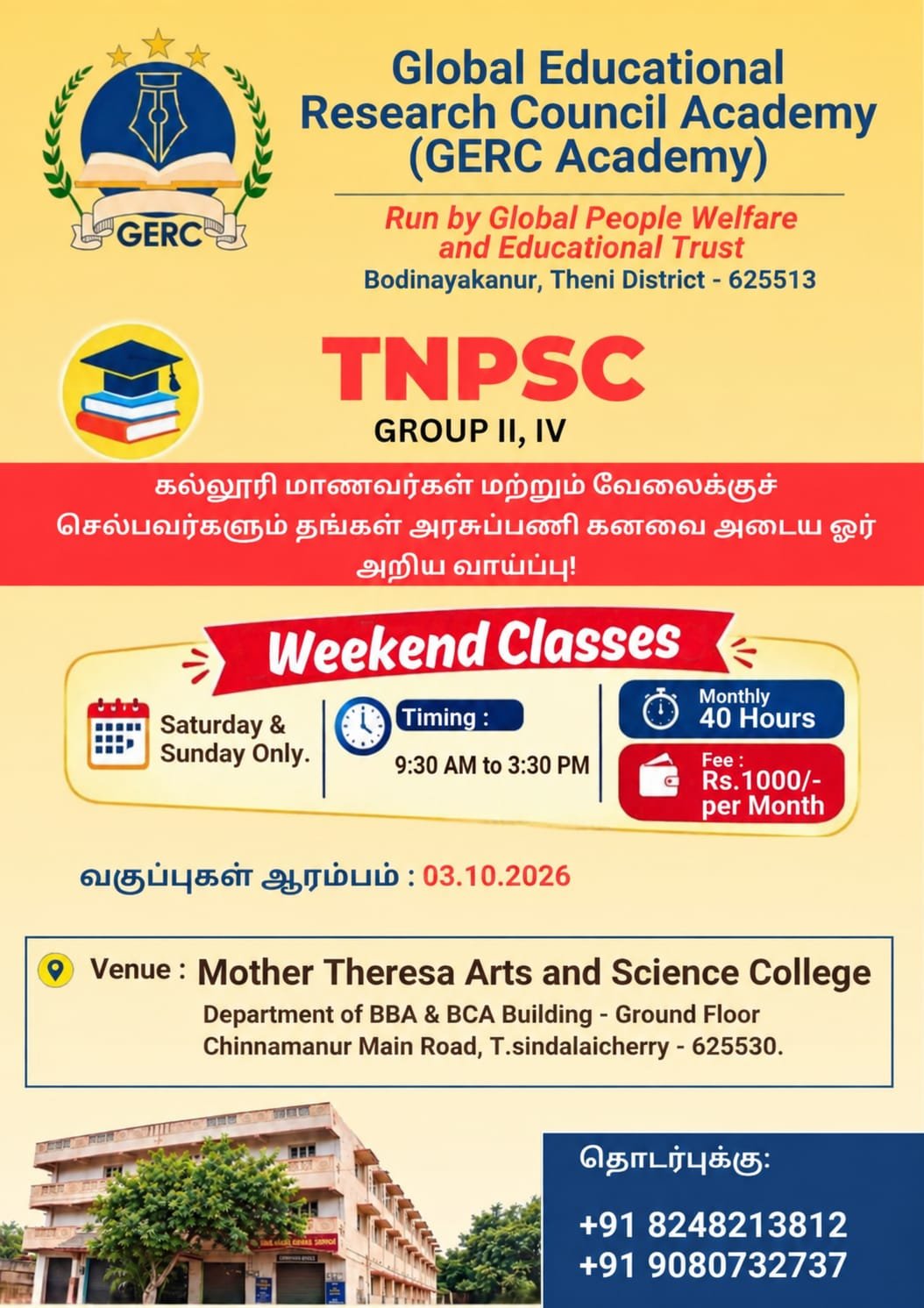
Weekend classroom coaching for TNPSC aspirants, with a structured monthly schedule at GERC Academy.
Transforming education through research, innovation, and strategic partnerships. GERC is committed to advancing excellence across institutions, faculty, and students worldwide.
Years of Excellence
Students Impacted
Affiliated to NITI Aayog, Govt of India
ISO 9001:2015 Certified
200+ Expert Professionals
The Global Educational and Research Council (GERC) was established in 2023 under the 'Global People Welfare and Educational Trust,' driven by the vision of ensuring equal access to quality education and research opportunities for all. GERC supports students, researchers, academicians, and professionals across diverse fields, including education, science, technology, engineering, mathematics, agriculture, social sciences, medical sciences, management, environmental studies, and artificial intelligence. The organization offers a wide range of opportunities through membership, research conferences, publications, journals, seminars, workshops,fellowships, in-person and online learning platforms, internships, and professional training programs. Demonstrating its commitment to academic excellence and the advancement of research, GERC has secured several accreditations and registrations. These include the Government of India’s 'NGO Darpan' registration (TN/2023/0364225), MSME registration (TN-23-0067057), Government of Tamil Nadu registration (Bodinayakanur/Book/-4/19/2026), and ISO 9001:2015 certification (GCS/QMS/8157).
Comprehensive solutions for educational and research excellence
Our organization promotes academic excellence and research development through the planning and conduct of International Conferences, National Conferences, State-Level Conferences, Symposia, Seminars, Workshops, Faculty Development Programmes (FDPs), Training Programmes, Research Methodology Programmes, and Academic Publication Activities. These events may be organized in online, offline, or hybrid modes, either independently or in collaboration with universities, colleges, research institutions, professional bodies, NGOs, industries, and academic organizations. We also support the publication of research papers, edited books, conference proceedings, journals, book chapters, and scholarly articles. In addition, we offer opportunities for Research Fellowships, Internships, Academic Memberships, Research Guidance, Networking, Skill Development, and Capacity Building to students, scholars, faculty members, and professionals. Through collaborative and multidisciplinary initiatives, we strive to create a vibrant research ecosystem that encourages innovation, knowledge sharing, and societal development at local, national, and international levels.
Internships are structured learning and training programs that provide students, scholars, and professionals with practical exposure to real-world work environments. They may be conducted in online, offline, or hybrid modes, enabling participants to develop professional skills, gain hands-on experience, enhance employability, and apply academic knowledge in practical settings. Internship programs can be offered in various disciplines such as education, research, technology, management, healthcare, social work, and entrepreneurship. Participants typically receive mentorship, project-based learning opportunities, skill development training, performance evaluation, and a certificate upon successful completion. These programs help bridge the gap between academic learning and professional practice while fostering career readiness and lifelong learning.
Membership provides an opportunity for individuals, researchers, academicians, students, professionals, and institutions to become part of a dynamic academic and research community. Through membership, participants can engage in scholarly activities, including international and national conferences, seminars, workshops, symposiums, faculty development programmes, research projects, internships, fellowships, publications, and collaborative initiatives. Members gain access to academic resources, networking opportunities, professional development programmes, research guidance, and recognition for their contributions. Membership promotes knowledge sharing, innovation, lifelong learning, and interdisciplinary collaboration, helping members enhance their academic, research, and professional growth while contributing to the advancement of education and research at regional, national, and international levels.
JEE coaching and preparation programs provide comprehensive support for students aspiring to secure admission to premier engineering institutions in India. The program includes online mode training, mock examinations, practice tests, subject-wise assessments, doubt-clearing sessions, live and recorded classes, previous-year question paper discussions, and performance analysis. Students receive structured guidance in Physics, Chemistry, and Mathematics through regular practice exams and expert mentoring. The online learning platform enables flexible preparation from any location while helping students improve problem-solving skills, time management, and examination confidence for success in JEE Main and JEE Advanced.
GERC NEET Coaching Centre provides a comprehensive online learning platform designed to help medical aspirants achieve success in the NEET examination. The coaching methodology includes live and recorded classes, chapter-wise tests, unit tests, grand tests, and full-length NEET model examinations conducted in an online format. Regular mock tests are designed to simulate the actual NEET examination pattern, helping students improve time management, accuracy, problem-solving skills, and exam confidence. Detailed performance analytics, subject-wise score analysis, and progress tracking enable students to identify strengths and areas requiring improvement. Consistent mock testing and performance review are widely regarded as essential components of effective NEET preparation. � NEET Online Coaching +1 To ensure conceptual clarity, GERC offers a structured doubt-clearing mechanism through online discussion sessions, faculty interaction, personalized mentoring, and problem-solving workshops. Students can submit doubts during live classes or through dedicated online support channels, where subject experts provide timely explanations and guidance. Doubt-resolution sessions are integrated with test analysis so that students can understand mistakes, strengthen weak concepts, and improve future performance. Regular revision programs, NCERT-based practice, and continuous academic monitoring help learners build confidence and achieve excellence in the NEET examination.
The Olympiad programmes conducted by the Global Educational Research Council are designed to identify, nurture, and recognize talented students in various academic and creative domains. These competitions encourage critical thinking, problem-solving ability, creativity, innovation, and academic excellence among school and college students. Through national and international participation, students gain opportunities to benchmark their skills, enhance their confidence, and achieve academic recognition. The major Olympiad initiatives include Global India Math Olympiad (GIMO), Global India Science Olympiad (GISO), and Global India Arts Olympiad (GIAO). GIMO focuses on mathematical reasoning, logical thinking, and advanced problem-solving skills; GISO promotes scientific inquiry, experimentation, and application of scientific concepts across various disciplines; while GIAO encourages artistic creativity, imagination, and visual expression through innovative art-based competitions. These Olympiads provide a platform for students to showcase their talents, receive certificates, medals, awards, and gain exposure to national and international standards of excellence.
The Global Educational Research Council (GERC) conducts a wide range of Awards and Recognition Programmes to acknowledge and celebrate the exceptional contributions of students, teachers, researchers, academicians, educational administrators, institutions, professionals, innovators, and social contributors. These programmes are designed to recognize excellence in teaching, research, publications, innovation, leadership, entrepreneurship, community service, skill development, and academic achievement. GERC provides recognition through national and international award platforms, encouraging individuals and organizations to pursue continuous improvement and contribute to the advancement of education, research, and society. The awards may include certificates, medals, trophies, mementos, appreciation letters, honorary titles, and special recognitions for outstanding performance and achievements. Through these initiatives, GERC aims to inspire excellence, promote quality education and research, encourage innovative practices, and create a strong network of distinguished scholars, educators, and professionals committed to lifelong learning and sustainable development. Furthermore, GERC recognizes achievements in both online and offline modes through conferences, seminars, workshops, publications, competitions, and community engagement activities, ensuring that deserving individuals and institutions receive the recognition they merit at regional, national, and international levels.
The Global Educational Research Council (GERC) promotes international collaboration by connecting researchers, academicians, educational institutions, professionals, and students across different countries. Through collaborative research projects, international conferences, seminars, workshops, faculty exchange programmes, student exchange initiatives, joint publications, training programmes, and academic partnerships, GERC fosters global knowledge sharing and innovation. These collaborations help strengthen research quality, enhance professional development, encourage cultural exchange, and create opportunities for addressing global educational and societal challenges through collective efforts.

GERC Career & Employability Certificate Courses are designed to equip students, graduates, teachers, researchers, and professionals with industry-relevant knowledge, practical skills, and globally recognized competencies. The programmes focus on enhancing employability, career advancement, entrepreneurship, and lifelong learning through short-term, job-oriented certificate courses. Delivered in online, offline, and hybrid modes, these courses combine expert-led training, hands-on projects, assessments, and certification to prepare learners for the evolving demands of the global workforce. GERC is committed to bridging the gap between academic learning and industry expectations by empowering individuals with future-ready skills and professional excellence. Tagline: "Learn Today. Lead Tomorrow. Build Your Career with GERC."
Join GERC and become part of a global community dedicated to advancing education and research. We offer comprehensive membership programs for faculty, researchers, and students.
For faculty members, researchers, and professionals in education and academia.
Annual Membership: ₹5,000
or
Life Membership: ₹25,000
For undergraduate and postgraduate students passionate about research and innovation.
Annual Membership: ₹2,000
or
Life Membership: ₹10,000
For colleges, schools, and educational institutions seeking to partner with GERC.
Annual Membership: ₹15,000
or
Life Membership: ₹75,000
Take the first step towards professional growth and global recognition. Our membership process is simple and transparent.
Apply for MembershipFill out the membership application form with your details and qualifications.
Our team will verify your credentials and qualifications within 2-3 business days.
Make the membership fee payment through our secure online portal.
Receive your membership ID, certificate, and detailed welcome package via email.
Partnerships, academic programmes, and recent GERC activities
Dhanalakshmi Srinivasan University, Tiruchirappalli, and the Global Educational Research Council (GERC) signed a Memorandum of Understanding to promote education, research, and skill development.
Dr. C. K. Ranjan, Vice-Chancellor of Dhanalakshmi Srinivasan University, and Dr. R. Satheeshkumar, Founder and Chairman of GERC, exchanged the MoU documents. The event was graced by Dr. S. Selvakumar, Registrar; Dr. K. Chozhan, Dean, School of Agricultural Sciences, DSU; and Dr. M. Daniel Jebaraj, National President, RAAST India.
AGRI TECHNOVA 2026 was organised by Dhanalakshmi Srinivasan University and RAAST India, with coordination support from GERC. Ahead of the conference, an informal interaction and refreshment meeting was held with Chief Guest Mr. V. Balakrishnan, IPS, Inspector-General of Police, Central Zone, Tiruchirappalli.
The meeting was attended by Dr. Velu Rajesh Kannan, Vice-Chancellor of Bharathidasan University, and Dr. C. K. Ranjan, Vice-Chancellor of Dhanalakshmi Srinivasan University. Also present were Dr. M. Daniel Jebaraj, National President, RAAST India; Prof. Dr. A. Pal Pandi, National Secretary, RAAST India; and Mr. Joshua, President, Agri Amigos.
Representing the Central Silk Board were Dr. S. Rajaram, Director, METVSO Research Foundation and former Senior Scientist, and Dr. A. Mahima Santhi, Senior Scientist and Joint Director, CSB Research Extension Centre. Dr. R. Satheeshkumar, Chairman of GERC, also participated.
Dr. R. Satheeshkumar, Chairman of GERC, delivered a speech at AGRI TECHNOVA 2026, organised by Dhanalakshmi Srinivasan University and RAAST India with coordination support from GERC. He was honoured by the Registrar and Dean of Dhanalakshmi Srinivasan University.
The Chief Guest was Mr. V. Balakrishnan, IPS, Inspector-General of Police, Central Zone, Tiruchirappalli. Delegates included Dr. Velu Rajesh Kannan, Vice-Chancellor of Bharathidasan University; Dr. C. K. Ranjan, Vice-Chancellor of Dhanalakshmi Srinivasan University; Dr. M. Daniel Jebaraj, National President of RAAST India; and Prof. Dr. A. Pal Pandi, National Secretary of RAAST India.
Representing the Central Silk Board were Dr. S. Rajaram, Director of the METVSO Research Foundation and former Senior Scientist, and Dr. A. Mahima Santhi, Senior Scientist and Joint Director, CSB Research Extension Centre. The event brought together delegates from education, research, and public service.
GERC successfully conducted a hands-on training programme on AI and digital skills. The programme covered AI tools and prompt engineering, as well as graphic designing and video editing using AI tools.
GERC thanks the Chief Guest, Resource Person, participants, and the GERC team for contributing to the programme. Learn, create, innovate, and empower.
The GERC Internship evaluation, valedictory, and demo class was completed at Mother Theresa Arts and Science College, T. Sindalaichery, Theni District.
GERC extends its sincere thanks to Chief Guest Mr. R. Bastin Jesuraj, MCA, M.Phil., Correspondent and Secretary, the management, faculty members, students, and everyone who contributed to the programme. Learn, grow, and inspire.
GERC Academy, run by the Global Educational Research Council, and Mother Theresa Arts and Science College, affiliated with Madurai Kamaraj University, signed a Memorandum of Understanding to establish and operate a Competitive Examinations Coaching Centre and promote academic excellence, skill development, and research initiatives.
The MoU was signed by Dr. R. Satheeshkumar, Ph.D., Chairman, and P. Kiruthiga, M.Sc., B.Ed., Director, representing GERC Academy, and Dr. P. A. Peter, President, and Mr. R. Bastin Jesuraj, MCA, Secretary and Correspondent, representing the College.
Academic Collaboration
Dhanalakshmi Srinivasan University
Mother Theresa Arts and Science College
 INDIAN FOREIGN SERVICE OFFICER.jpeg)
INDIAN FOREIGN SERVICE OFFICER
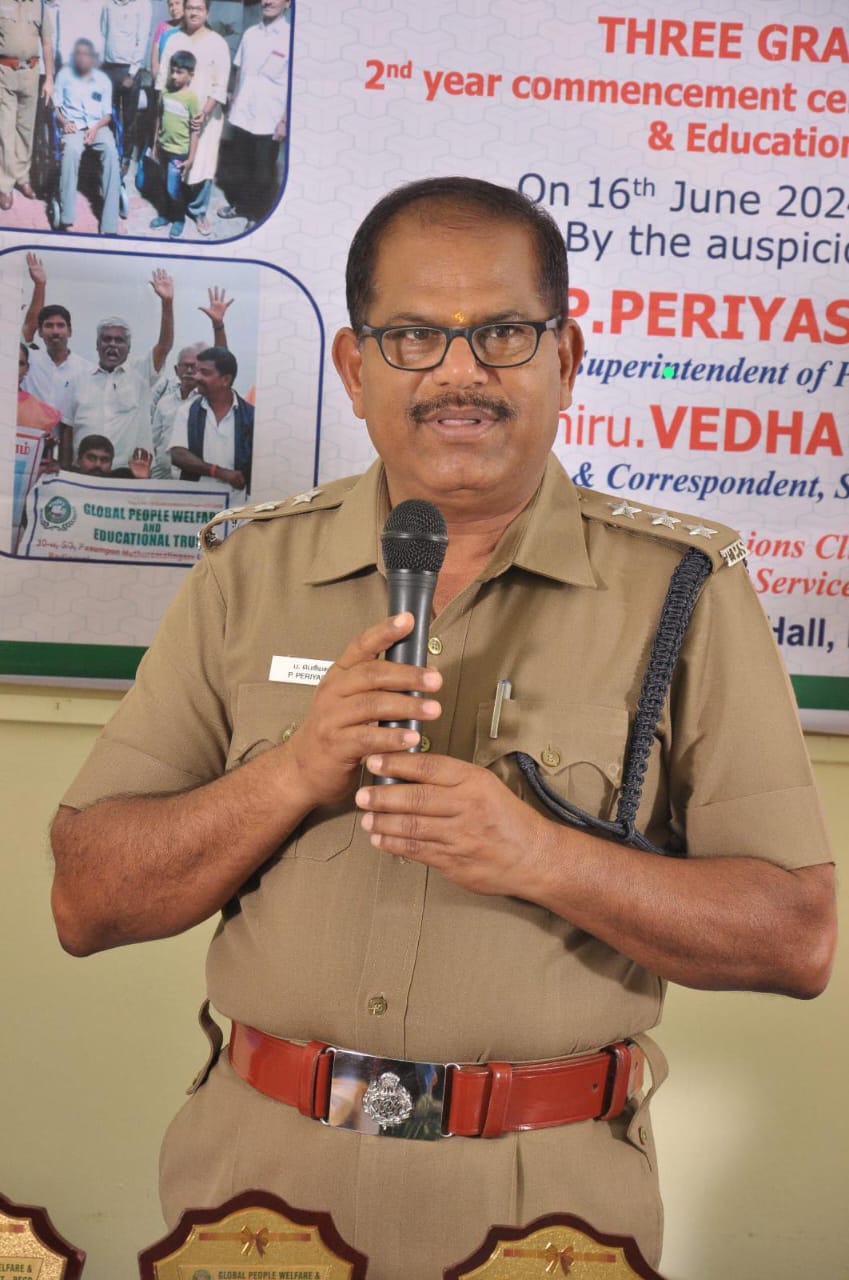
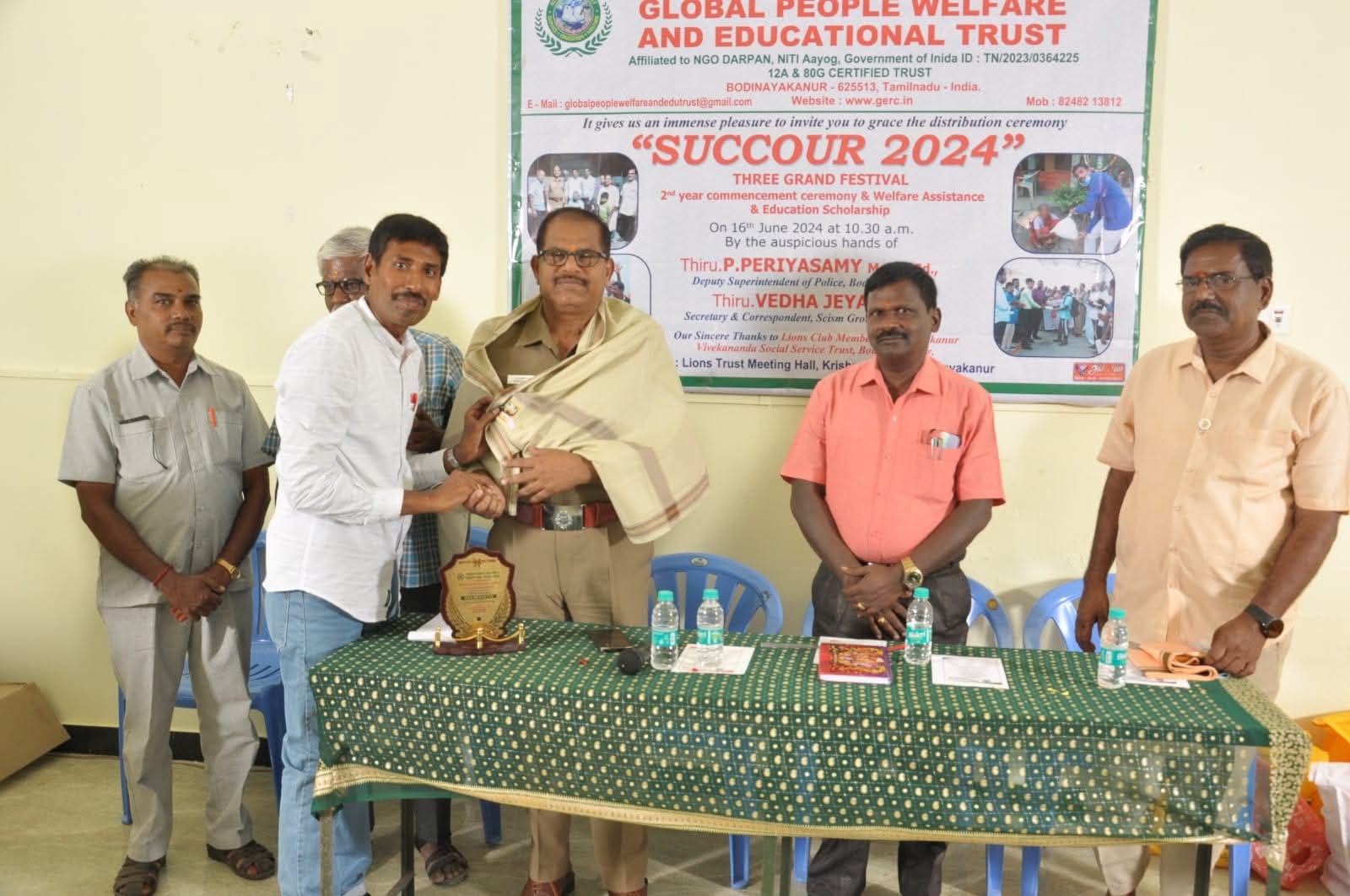
DEPUTY SUPERINTENDENT OF POLICE
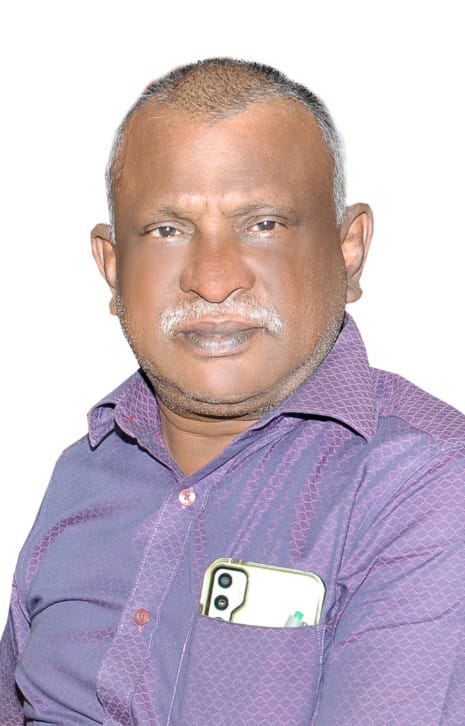
BLOCK EDUCATONAL OFFICER
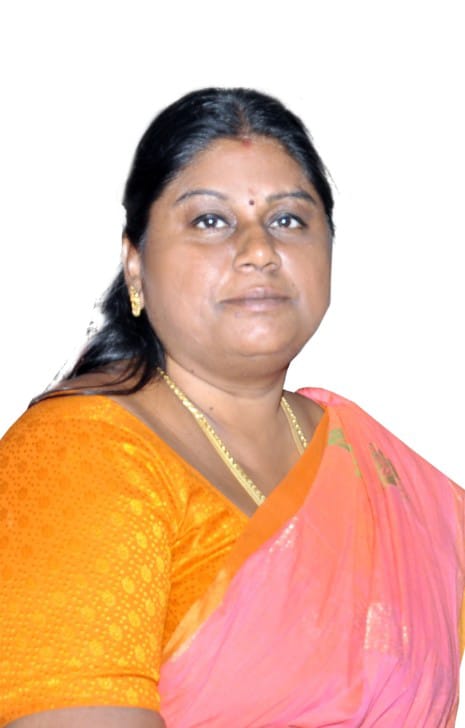
BLOCK EDUCATIONAL OFFICER
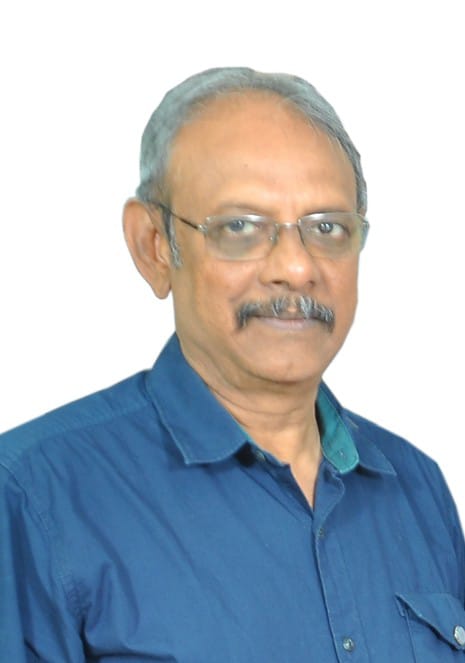
SECRETARY AND CORRESPONDENT, SCISM GROUP OF SCHOOL
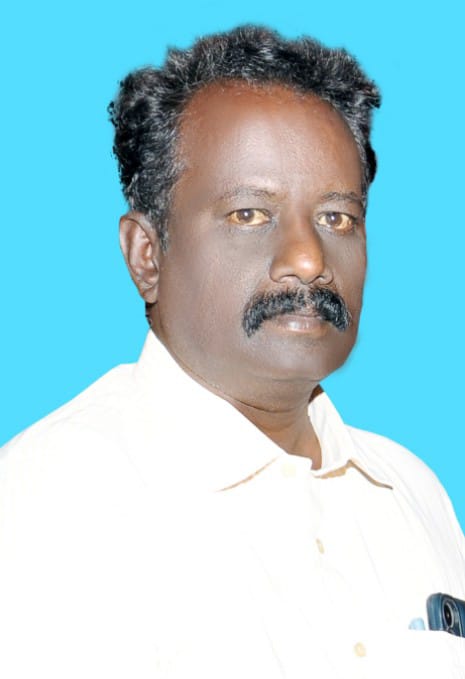
CORRESPONDENT REAVEN ENGLISH SCHOOL